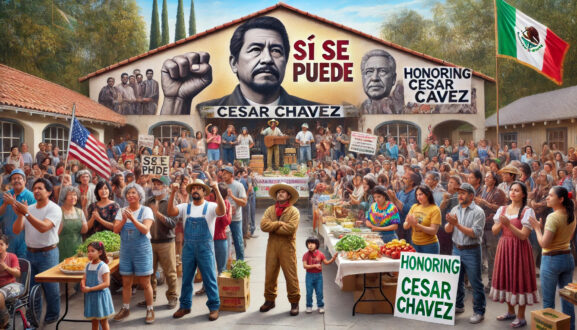
Nevada Lawmakers Reconsider Cesar Chavez Day Holiday Status After Allegations
The recent reconsideration of Nevada lawmakers regarding the holiday status of Cesar Chavez Day has ignited a multifaceted debate that transcends mere legislative procedure. Once a symbol of solidarity and labor rights, the holiday now finds itself at the crossroads of historical reevaluation and contemporary scrutiny. The allegations prompting this reconsideration are not merely administrative; they delve into the very fabric of how we commemorate figures whose legacies are both celebrated and contested. This shift reflects a broader societal reckoning with the complexities of historical memory, where reverence often collides with the demands of accountability.
The Allegations and Their Ripple Effects
The catalyst for Nevada’s reconsideration stems from a series of allegations that have cast a shadow over Cesar Chavez’s legacy. Critics argue that the sanitized narrative of Chavez’s life—one of unwavering heroism—has obscured less palatable aspects of his leadership and the United Farm Workers (UFW) movement. Accusations of authoritarian tendencies, suppression of dissent within the union, and even racial insensitivity have surfaced, challenging the monolithic portrayal of Chavez as an infallible icon. These revelations have not emerged in a vacuum; they are part of a growing trend where historical figures are dissected through the lens of modern ethical standards, revealing contradictions that were once overlooked or excused as necessary for the greater good.
The Holiday’s Symbolic Weight
Cesar Chavez Day, observed on March 31st, is more than a day off; it is a symbol of labor rights, immigrant solidarity, and social justice. For many, it represents the culmination of Chavez’s lifelong crusade to improve the conditions of farmworkers, a struggle that resonated deeply in a state like Nevada, where agriculture and hospitality industries rely heavily on immigrant labor. However, the holiday’s symbolic power is now being tested. If the allegations are substantiated, the question arises: Can a figure whose methods or personal conduct are deemed flawed still be celebrated in a way that divorces their legacy from these controversies? This dilemma is not unique to Chavez; it mirrors broader debates about how societies honor historical figures whose contributions are intertwined with morally ambiguous actions.
The Political and Cultural Divide
The reconsideration of the holiday status has laid bare a stark political and cultural divide. On one side, advocates argue that Chavez’s contributions to labor rights and civil justice are too significant to be overshadowed by personal or organizational flaws. They contend that the holiday serves as a reminder of the progress made in workers’ rights, regardless of the complexities of its namesake. On the other side, detractors assert that honoring Chavez without acknowledging these controversies is a form of historical revisionism, one that perpetuates a narrative that prioritizes myth over truth. This divide is not merely ideological; it reflects deeper tensions about how history is taught, remembered, and institutionalized in public life.
The Broader Implications for Historical Commemoration
Nevada’s deliberation over Cesar Chavez Day is emblematic of a larger reckoning with how societies commemorate historical figures. The movement to reevaluate holidays, statues, and public tributes is not just about correcting the past; it is about redefining the present. It forces us to confront uncomfortable questions: Who deserves to be celebrated? What aspects of a person’s life should be emphasized or omitted? And how do we balance the need for historical inspiration with the demand for moral integrity? These questions are particularly pertinent in a time when social justice movements are reshaping the cultural landscape, demanding a more nuanced and critical engagement with history.
The reconsideration of Cesar Chavez Day in Nevada is more than a political maneuver; it is a microcosm of a society grappling with the legacy of its heroes. As lawmakers weigh the evidence and public opinion, the outcome will send a signal far beyond the borders of the Silver State. It will shape how future generations remember not just Chavez, but the very idea of heroism itself. In this moment, the holiday stands as a testament to the enduring tension between reverence and scrutiny—a tension that will continue to define our collective memory for years to come.