
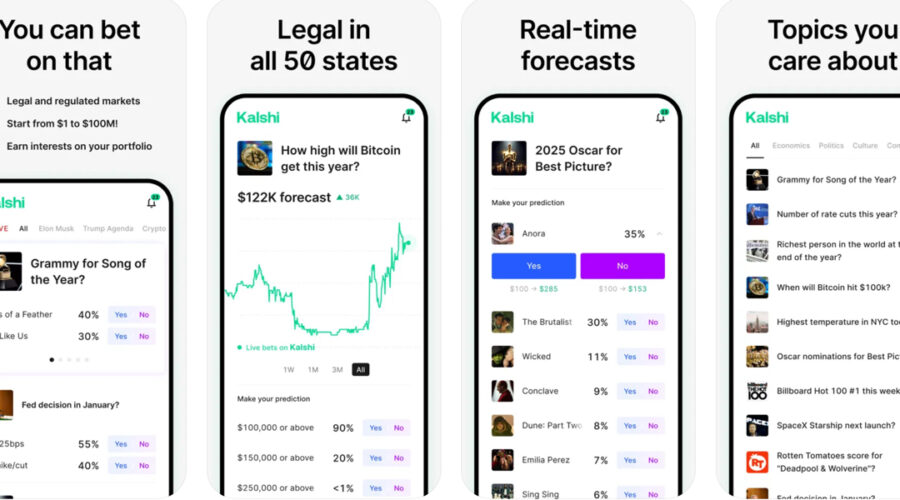
Are prediction markets legal in Nevada? No but Kalshi ads still appear
Prediction markets, where participants wager on the outcomes of future events—from elections to sports—have long occupied a legal gray area in the United States. Nevada, a state synonymous with gambling innovation, presents a paradox: while its regulatory framework is among the most permissive in the nation, it has drawn a firm line against these speculative platforms. Yet, despite this prohibition, advertisements for platforms like Kalshi continue to proliferate across digital landscapes, leaving many to wonder: why does the allure of prediction markets persist even where they are technically illegal?
At the heart of this discrepancy lies Nevada’s stringent stance on prediction markets, rooted in its interpretation of gambling laws. The state’s regulatory bodies, including the Nevada Gaming Control Board, classify prediction markets as a form of sports betting or gambling, which falls under the purview of the Nevada Gaming Commission. Unlike traditional sportsbooks, which operate under strict licensing, prediction markets often rely on peer-to-peer wagering mechanisms that do not fit neatly into existing frameworks. This legal ambiguity has led Nevada to adopt a cautious approach, effectively banning these platforms within its jurisdiction. The rationale is straightforward: without a clear regulatory pathway, the state errs on the side of caution to prevent potential exploitation or financial harm to participants.
Yet, the persistence of Kalshi’s advertisements in Nevada—and indeed across the country—hints at a deeper cultural fascination with prediction markets. These platforms tap into a primal human desire: the ability to peer into the future and hedge against uncertainty. In an era where data analytics and algorithmic forecasting dominate decision-making, prediction markets offer a democratized alternative, blending crowd wisdom with financial incentive. The allure is not merely speculative; it is participatory. For many, the act of betting on an event’s outcome becomes a form of engagement, a way to assert agency in an unpredictable world. This psychological pull transcends legal boundaries, creating a market for these platforms even where they are technically prohibited.
The disconnect between Nevada’s legal stance and the ubiquity of Kalshi’s presence also underscores the challenges of enforcing such prohibitions in the digital age. The internet does not respect state lines, and advertisements for these platforms can be disseminated globally with minimal effort. Nevada’s regulatory reach, while robust within its borders, struggles to curb the spread of these promotions beyond its jurisdiction. This creates a cat-and-mouse dynamic, where platforms operate in a legal limbo, exploiting gaps in enforcement while regulators scramble to adapt. The result is a patchwork of compliance, where some states embrace prediction markets while others, like Nevada, remain steadfast in their opposition.
Beyond the legal and regulatory hurdles, prediction markets challenge conventional notions of gambling by framing themselves as tools for information aggregation. Proponents argue that these platforms provide valuable insights into public sentiment, market expectations, and even potential outcomes of future events. In this view, the act of trading predictions is less about gambling and more about collective intelligence—a modern oracle where the wisdom of the crowd converges into a single, tradable asset. This narrative resonates in an era where misinformation and uncertainty abound, offering a semblance of order amidst chaos.
For all their promise, however, prediction markets remain a contentious innovation. Critics warn of the risks of manipulation, where coordinated groups could skew outcomes or exploit loopholes for financial gain. The potential for insider trading or the spread of misinformation further complicates their legitimacy. Yet, the very controversies that surround them fuel their intrigue, turning prediction markets into a cultural phenomenon as much as a financial one. They represent a collision of technology, psychology, and regulation—a testament to humanity’s enduring quest to conquer uncertainty.
In the end, the question of whether prediction markets are legal in Nevada is less about the platforms themselves and more about the evolving landscape of digital finance. While the state’s regulators stand firm in their prohibition, the persistence of these platforms—and their advertisements—reveals a fundamental truth: the human fascination with forecasting the future is not easily contained by laws or borders. It thrives in the shadows of regulation, in the gaps between jurisdictions, and in the collective imagination of a world hungry for certainty. Until the day when prediction markets find a universally accepted framework, they will continue to captivate, confound, and challenge the status quo.