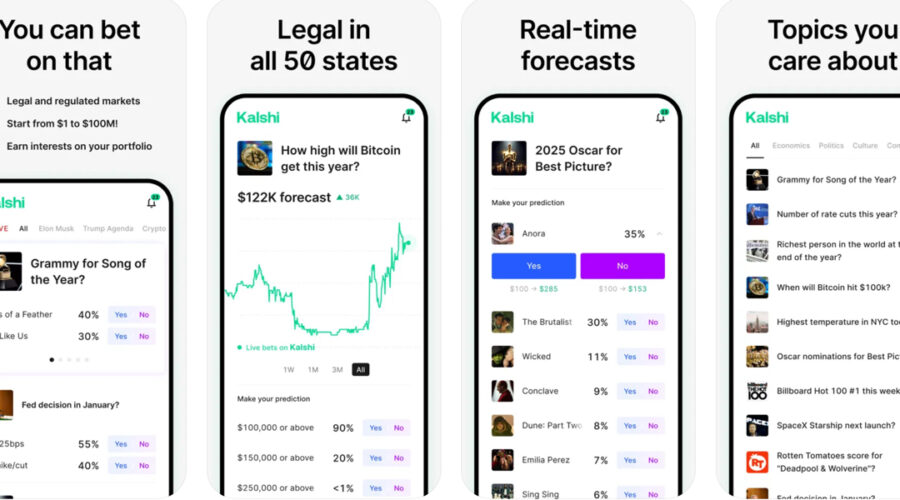
The Kalshi Paradox: A First Amendment Argument for Prediction Markets
In an era where information is both currency and weapon, the right to predict the future—without fear of reprisal—emerges as the last bastion of free expression. The Kalshi paradox, a conundrum that pits financial innovation against regulatory orthodoxy, is not merely about trading contracts on elections or sports outcomes. It is a philosophical crucible where the First Amendment’s guarantees collide with the state’s paternalistic impulse to shield citizens from their own speculative impulses. To dismiss Kalshi as a mere betting platform is to overlook its potential as a laboratory for democratic discourse, where the act of prediction becomes an act of resistance against the tyranny of uncertainty.
The First Amendment as a Marketplace of Ideas
The Supreme Court’s articulation of the marketplace of ideas—where truth emerges from the clash of competing narratives—finds an unlikely ally in prediction markets. These platforms do not merely aggregate opinions; they distill collective wisdom into quantifiable probabilities, transforming abstract beliefs into tangible stakes. When users wager on geopolitical events or corporate earnings, they are not merely speculating—they are participating in a real-time dialectic, where every contract reflects a hypothesis, every trade a rebuttal. This is not gambling in the traditional sense; it is the democratization of foresight, where the First Amendment’s protections extend beyond speech to the very act of forming and expressing probabilistic judgments. The paradox lies in the fact that while governments regulate speech to prevent harm, prediction markets regulate harm by channeling it into a controlled, transparent system—one that thrives on the free exchange of ideas rather than their suppression.
The Illusion of Harm and the Reality of Information
Regulators often justify restrictions on prediction markets by invoking the specter of manipulation or the psychological toll of speculative losses. Yet, these concerns are rooted in a fallacy: the assumption that individuals are incapable of rational engagement with risk. The data suggests otherwise. Studies on prediction markets demonstrate that participants, when incentivized by accurate information, converge on outcomes that often outperform expert forecasts. The harm, if any, is not in the activity itself but in the opacity that surrounds it. By legalizing and regulating these markets, society does not invite chaos—it invites clarity. The Kalshi paradox thus becomes a mirror, reflecting the tension between a government’s desire to protect and its obligation to empower. The First Amendment, in this context, is not a shield against harm but a scalpel that dissects ignorance, revealing the contours of truth in the process.
The Regulatory Labyrinth and the Cost of Silence
The path to legitimizing prediction markets is fraught with bureaucratic obfuscation. Agencies like the CFTC and SEC operate within a framework that predates the digital age, where the line between gambling and financial innovation is drawn with the blunt instrument of precedent rather than the scalpel of nuance. The result? A patchwork of exemptions and prohibitions that stifles innovation while failing to address the core issue: the right to engage in speculative reasoning. The Kalshi paradox, in this light, is a symptom of a larger malaise—a regulatory system that prioritizes control over curiosity, uniformity over experimentation. The cost of this silence is not merely economic; it is epistemological. When prediction markets are relegated to the shadows, society loses a vital tool for navigating uncertainty, one that could otherwise serve as a barometer of public sentiment, a predictor of systemic risks, or even a corrective to institutional bias.
Beyond Betting: The Civic Potential of Prediction Markets
The implications of Kalshi’s model extend far beyond the realm of finance. Imagine a world where prediction markets are integrated into civic education, allowing students to model the outcomes of historical events or policy decisions in real time. Envision corporations using these platforms to crowdsource risk assessments, turning employees and customers into stakeholders in the decision-making process. Consider the role such markets could play in journalism, where reporters and readers alike could wager on the veracity of claims, creating a self-correcting mechanism for misinformation. The First Amendment, in this expanded view, is not just a legal doctrine but a technological catalyst—one that could redefine how societies grapple with uncertainty. The Kalshi paradox, then, is not a problem to be solved but an opportunity to be seized: a chance to reimagine the boundaries of free expression in an age where the future is no longer a distant abstraction but a commodity to be traded, debated, and democratized.
The Kalshi paradox forces us to confront an uncomfortable truth: the First Amendment was never meant to protect only the speech we agree with or the ideas we find palatable. It was designed to protect the speech that unsettles us, the ideas that challenge us, and the futures we dare to imagine. In the quiet hum of servers processing trades on election outcomes and market crashes, there is a quiet revolution underway—one where the right to predict becomes the right to participate, and where the marketplace of ideas evolves into a marketplace of foresight. The question is not whether we can afford to embrace this shift, but whether we can afford not to.