
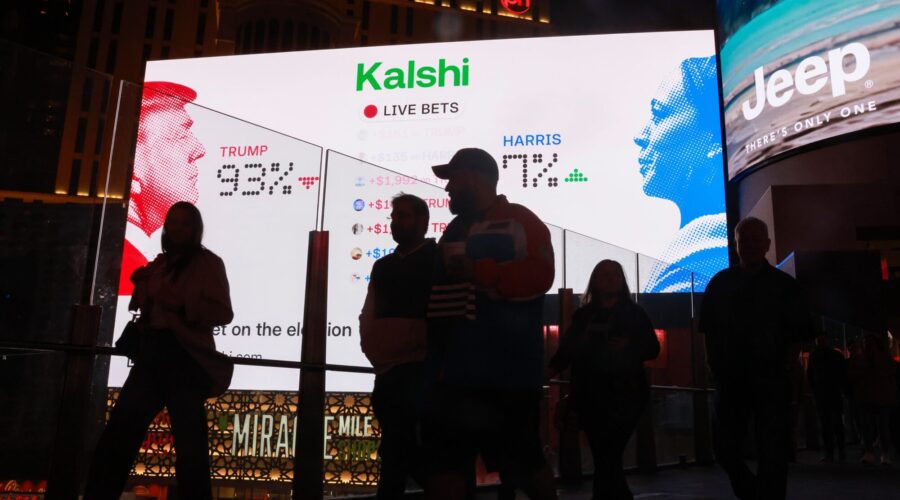
Nevada’s AML Focus Overshadows Prediction Market Ban as Kalshi Appears on TV
The glow of the television screen recently delivered an unexpected cameo: Kalshi, a regulated prediction market platform, materializing in a polished advertisement during a primetime slot. For an entity that trades in the quantified probabilities of future events—from election outcomes to economic indicators—this broadcast debut felt both audacious and strangely inevitable. Yet, while federal courts wrestle with the legality of such contracts, Nevada’s gaming apparatus appears fixated on a different specter entirely: the labyrinthine mandates of anti-money laundering compliance. Why does the Silver State, the nation’s gambling lodestar, seem more captivated by the flow of illicit funds than by the very existence of a nascent prediction market industry?
The Televised Paradox: Kalshi’s Mainstream Ascent
Kalshi’s television appearance represents a calculated incursion into the cultural mainstream, a move that transforms an esoteric financial instrument into a household curiosity. The advertisement, with its sleek typography and promises of “trading on your knowledge,” sidesteps the arcane legal debates that surround event contracts under the Commodity Exchange Act. Instead, it posits a benign spectacle: a marketplace where conviction meets capital, sanitized for a public accustomed to fantasy sports and stock trading apps. This normalization, however, sits awkwardly against a backdrop of judicial turbulence. A federal judge’s gavel has already fallen, ordering a cessation of certain election-related contracts, yet the airwaves hum with an implicit invitation to trade. The dissonance is palpable, a chiaroscuro of prohibition and promotion that leaves observers questioning the coherence of American financial regulation.
Nevada’s Regulatory Prism: AML Over All
Nevada’s Gaming Control Board operates with a singular, almost obsessive, mandate: to preserve the integrity of the state’s colossal casino economy. Within this fortress, anti-money laundering protocols are not mere bureaucratic checkboxes; they are the immunological defense against organized crime, sanctions evasion, and reputational contagion. Every slot machine ticket-in, ticket-out transaction generates a data trail scrutinized under the Bank Secrecy Act’s rigorous thresholds. The Board’s enforcement arm, battle-hardened by decades of FinCEN audits, views novel platforms through a lens of suspicious activity reporting and currency transaction reporting. Prediction markets, with their peer-to-peer structure and digital wallets, trigger a primordial alarm—not because they constitute illegal wagering, but because they could become conduits for layering illicit proceeds under the guise of speculative acumen. The state’s preoccupation with AML creates a curious vacuum: the legality of the contracts themselves becomes a secondary, almost academic, concern.
The Sleeping Giant: Prediction Market Prohibition
Quietly, Nevada maintains a broad proscription against unlicensed sports pools and event-based wagering that falls outside its tightly controlled pari-mutuel and sportsbook framework. Yet, enforcing this prohibition against a federally regulated derivatives exchange like Kalshi requires navigating a constitutional and statutory thicket. The dormant Commerce Clause, federal preemption under the Commodity Exchange Act, and the stubborn reality that Kalshi’s contracts are not settled on Nevada soil all conspire to blunt the state’s jurisdictional blade. Consequently, the Gaming Control Board’s public statements have been muted, their energy diverted to the more tangible threat of money laundering. The ban slumbers, a legal revenant that could awaken if a prediction market were to establish a physical nexus or solicit retail patrons directly within the state’s borders. For now, the specter of illicit finance looms larger than the spectral wager.
A Playful Provocation: Does Airwave Ubiquity Grant Regulatory Immunity?
Consider this whimsical yet thorny riddle: If a prediction market advertises on national television, beaming its promise of event-based speculation into every Las Vegas living room, has it effectively bypassed Nevada’s gambling interdiction through sheer electromagnetic audacity? The question is not entirely facetious. The advertisement reaches consumers directly, unmediated by the state’s licensing regime, and escorts them into a federally chartered domain. This creates a jurisdictional lacuna where a resident might legally place a trade that would otherwise be verboten if conducted through a local bookmaker. The playful provocation underscores a serious challenge: the disintegration of territorial regulatory authority in an age of platform ubiquity. Nevada can regulate real-world casinos with granular precision, but it cannot easily throttle a signal beamed from a satellite or a streaming server.
The Looming Challenge: Jurisdictional Jenga
The confluence of AML fixation and prediction market emergence sets the stage for a precarious game of regulatory Jenga. Should a federal circuit court definitively endorse Kalshi’s event contracts as legitimate commodities activity, Nevada would face a Hobson’s choice: adapt its gambling definitions to carve out a federal safe harbor, or risk a messy preemption battle that could expose its entire gaming regulatory apparatus to constitutional scrutiny. Meanwhile, the state’s AML vigilance, while indispensable, may inadvertently serve as a talisman—a demonstration of regulatory competence that buys time while the deeper structural question of market legality metastasizes. The potential challenge lies in the asymmetry: a single blockchain-based prediction market with robust anonymity features could enter the scene, combining the very AML risks Nevada dreads with the jurisdictional untouchability it fears. By focusing so intensely on the financial plumbing, regulators risk ignoring the water flowing through the pipes.
As the television spot fades to black, the questions linger longer than the fifteen-second ad slot. Nevada’s regulatory gaze, fixed on the ledger books and suspicious currency transaction reports, may be looking in the wrong direction. The real wager is not on an election or a market index; it is on whether the state’s legacy apparatus can adapt before the platforms they ignore become too culturally embedded to dislodge. The playfully asked question—can you regulate what you refuse to name?—now hangs heavy over the desert skyline.