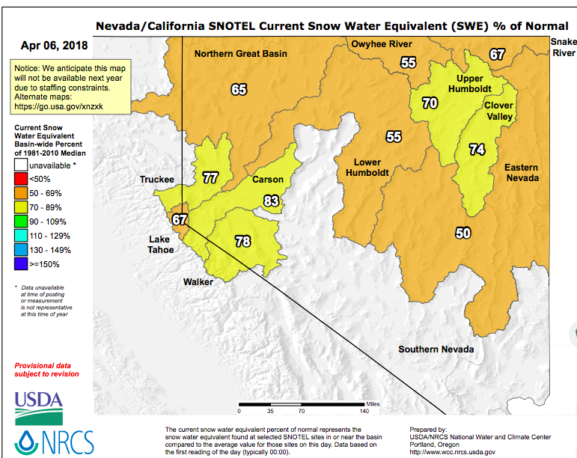
Nevada’s Snowpack Disaster: Only 17% of Median in Lake Tahoe Basin
The Sierra Nevada’s once-mighty snowpack, a lifeline for Nevada’s alpine ecosystems and urban water supplies, has dwindled to a mere shadow of its former self. In the Lake Tahoe Basin, the snowpack now clings to a dismal 17% of its median historical levels—a stark revelation that underscores the accelerating climate crisis gripping the American West. This isn’t just a seasonal anomaly; it’s a harbinger of systemic shifts that threaten the very foundations of regional resilience. As the snow recedes, it exposes deeper vulnerabilities in water management, ecological balance, and the delicate interplay between human ambition and natural limits.
The Vanishing White Mantle: A Crisis in the High Country
The Lake Tahoe Basin, renowned for its crystalline waters and towering pines, has long relied on a predictable snow cycle to sustain its delicate hydrological balance. Yet, this winter’s paltry accumulation—measured at just 17% of the median—paints a grim picture of a landscape starved for moisture. The implications are immediate and far-reaching. Snowpack acts as a natural reservoir, slowly releasing water into streams and aquifers as temperatures rise. Without it, the region faces a trifecta of threats: reduced drinking water supplies, diminished hydroelectric capacity, and the collapse of aquatic habitats critical to native species like the Lahontan cutthroat trout.
The causes are multifaceted. Rising global temperatures have truncated the snow season, while shifting storm tracks divert moisture away from the Sierra Nevada. Human activity, from deforestation to urban sprawl, has further eroded the land’s ability to retain snow. The result is a landscape where the once-ubiquitous white blanket now appears only in sporadic patches, a fleeting relic of a bygone era.
Water Scarcity and the Illusion of Control
Nevada’s reliance on snowmelt is not just a matter of convenience—it’s a cornerstone of its water security. The state’s arid climate and burgeoning population have long depended on the Sierra Nevada’s snowpack to fill reservoirs and recharge groundwater. With snow levels plummeting, the illusion of control over water resources is crumbling. Municipalities, already grappling with dwindling supplies, are forced to confront harsh realities: stricter conservation measures, potential rationing, and the daunting prospect of importing water from increasingly strained sources.
The psychological impact is equally profound. Communities accustomed to abundance now face the unsettling prospect of scarcity. Golf courses, once lush and verdant, may wither under mandatory cutbacks. Lawns, a symbol of suburban prosperity, could become relics of excess. The psychological toll of this transition—from entitlement to adaptation—cannot be overstated. It forces a reckoning with the fragility of human infrastructure in the face of natural forces.
The Ecological Unraveling: A Silent Alarm
Beneath the surface of this crisis lies an ecological unraveling that often goes unnoticed. The Lake Tahoe Basin’s flora and fauna evolved in tandem with the snowpack’s rhythms. Pines, firs, and cedars depend on deep snow for insulation against freezing temperatures. Amphibians and insects rely on snowmelt to replenish wetlands. When the snow fails, entire ecosystems teeter on the edge of collapse. The Lahontan cutthroat trout, a species already pushed to the brink by invasive species and habitat loss, now faces the added stress of shrinking streamflows. The loss of these species isn’t just an environmental tragedy—it’s a canary in the coal mine, signaling broader disruptions in the web of life.
Even the lake itself is not immune. Tahoe’s famed clarity is maintained by a balance of nutrients and sediment, much of which is regulated by snowmelt. As the snowpack diminishes, the lake’s chemistry shifts, threatening the very clarity that draws millions of visitors each year. The irony is stark: the same forces that starve the land of water may also obscure the lake’s legendary depths.
Adaptation in the Face of Uncertainty
In the face of such daunting challenges, adaptation is not optional—it’s imperative. Water managers are exploring innovative solutions, from cloud seeding to groundwater recharge projects. Cities are investing in desalination and wastewater recycling, though these measures come with their own environmental and economic costs. Conservation efforts, once seen as temporary measures, are now permanent fixtures of urban planning. The shift is seismic, reflecting a broader recognition that the old ways of managing water are no longer viable.
Yet adaptation requires more than technological fixes. It demands a cultural shift—a rejection of the notion that nature can be tamed. Indigenous communities, who have stewarded these lands for millennia, offer valuable lessons in resilience and harmony with the environment. Their knowledge, often overlooked in modern planning, could hold the key to sustainable coexistence with a changing climate.
The snowpack’s decline is not just a statistic; it’s a story of loss, adaptation, and the fragile interplay between human ambition and natural limits. As the white mantle of winter recedes, it leaves behind a landscape—and a society—forced to confront the consequences of its choices. The path forward is uncertain, but one thing is clear: the era of taking snow for granted is over. What remains to be seen is whether humanity can rise to the challenge before the last remnants of the Sierra’s snow vanish entirely.