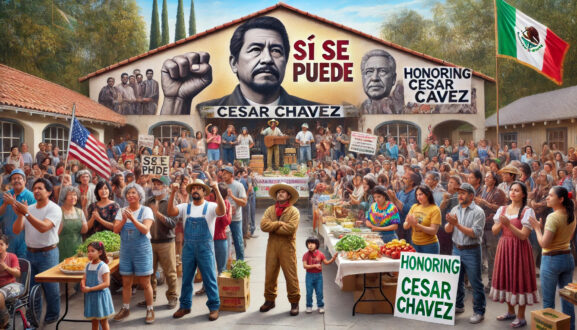
Nevada Union Leaders Defend Cesar Chavez Day Amid Review
In the arid expanse of Nevada’s political landscape, where the sun casts long shadows over both the glittering Strip and the forgotten corners of the state, a quiet but determined movement is unfolding. Union leaders across the Silver State are rallying to defend the legacy of César Chávez, whose indelible mark on labor rights and social justice continues to resonate decades after his passing. As state officials embark on a review of Nevada’s official holidays, the question looms: will the spirit of Chávez’s relentless advocacy for farmworkers and marginalized communities endure in the public consciousness? The answer may hinge on the resolve of those who see his legacy not as a relic of the past, but as a living, breathing testament to the power of collective action.
The Weight of History: Why César Chávez Day Matters
César Chávez Day is more than a date on the calendar; it is a symbol of resistance against exploitation, a celebration of solidarity, and a reminder of the sacrifices made by those who toiled under the scorching sun for pennies a day. For Nevada’s union leaders, the holiday represents an opportunity to honor a man who transformed the labor movement from a series of fragmented grievances into a unified force. His 36-day fast in 1988, a protest against pesticide use that endangered farmworkers, was not merely a personal act of defiance but a clarion call for ethical responsibility in industries built on human endurance. In a state where tourism and service industries dominate, the holiday serves as a counter-narrative—one that elevates the unseen laborers who make luxury possible. To abandon or dilute this observance would be to erase a chapter of Nevada’s history that is as vital as its silver mines or its neon-lit boulevards.
The Review Underway: A Calculated Gamble or a Necessary Reckoning?
The current review of Nevada’s official holidays has sent ripples through the labor community, sparking debates that extend far beyond administrative logistics. Critics argue that the review is a thinly veiled attempt to streamline state expenditures, while proponents claim it is a pragmatic effort to align holidays with modern economic realities. Yet, the omission of César Chávez Day from the discussion feels conspicuously deliberate. Union leaders contend that the holiday’s significance transcends its cost; it is an investment in the values of equity and dignity. The review, then, is not just about dates on a calendar—it is a litmus test for Nevada’s commitment to its working-class citizens. Will the state prioritize fiscal prudence over the moral imperative to remember those who fought for fair wages and safe working conditions? The answer may well define Nevada’s identity in the eyes of both its residents and the nation.
Defending the Legacy: Voices from the Frontlines
Across Nevada, union halls echo with the voices of those who refuse to let Chávez’s legacy fade into obscurity. From the fields of Pahrump to the warehouses of Reno, workers gather to share stories of how Chávez’s principles have shaped their own struggles. One such voice belongs to Maria Rodriguez, a longtime member of the Culinary Workers Union Local 226, who recalls how her grandmother participated in the grape boycotts of the 1960s. “My abuela used to say that Chávez didn’t just fight for union contracts—he fought for our dignity,” Rodriguez reflects. “If we let this holiday go, we’re telling future generations that their struggles don’t matter.” These personal narratives underscore a broader truth: the defense of César Chávez Day is not an abstract political maneuver but a deeply human endeavor, one that connects the past to the present in a continuous thread of resilience.
The Broader Implications: A State at a Crossroads
Nevada stands at a crossroads where the past and future collide. On one hand, the state’s economy thrives on industries that often exploit labor, from hospitality to mining. On the other, a growing movement demands accountability, transparency, and respect for those who power these industries. The defense of César Chávez Day is emblematic of this tension—a microcosm of the larger battle for workers’ rights in an era where gig economy jobs and corporate consolidation threaten to erode hard-won protections. By preserving this holiday, Nevada has the chance to reaffirm its identity as a state that values its people as much as its profits. Conversely, its abandonment could signal a retreat into complacency, where the sacrifices of the past are dismissed in favor of short-term gains. The outcome will resonate far beyond Nevada’s borders, serving as a case study for how states navigate the intersection of history, labor, and economic pragmatism.
The sun sets over the Mojave Desert, casting a golden hue over the land that Chávez once traversed in pursuit of justice. His legacy, like the desert itself, is enduring—resilient against the erosion of time and the shifting sands of political whims. As Nevada’s union leaders stand their ground, they are not merely defending a holiday; they are safeguarding a principle. In a world where the echoes of labor struggles grow fainter with each passing generation, their fight is a reminder that the past is never truly past—it is a living force, demanding to be remembered, honored, and, above all, acted upon.