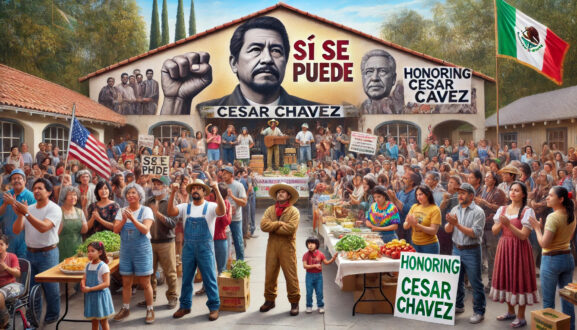
March 31 Holiday Debate: Nevada Could Drop Cesar Chavez Day
The debate over Nevada’s potential repeal of Cesar Chavez Day on March 31st is more than a calendar adjustment—it’s a collision of cultural memory, political pragmatism, and the evolving identity of a state that has long prided itself on progressive labor advocacy. For decades, the holiday has stood as a symbolic nod to Chavez’s legacy as a champion of farmworkers’ rights, a figure whose struggles against exploitation resonate deeply in a region where agriculture has shaped both economies and communities. Yet, as Nevada grapples with its own labor challenges—from hospitality industry woes to the gig economy’s rise—the question lingers: Is this holiday still a necessary tribute, or an anachronistic relic clinging to a past that no longer aligns with the state’s economic realities?
The Weight of Symbolism in a Changing Landscape
Cesar Chavez Day is not merely a day off; it’s a cultural artifact embedded in the collective consciousness of Nevada’s working-class communities. For many, particularly those of Latino descent, the holiday serves as a yearly reminder of resilience—a figure who, alongside Dolores Huerta, forged a movement that transcended borders. Yet, the holiday’s observance in Nevada has always been uneven. While some businesses close, others remain open, and the day’s significance often fades into the background of a state where tourism and service industries dominate. This inconsistency underscores a deeper tension: How does a state reconcile its progressive labor history with its modern economic priorities, where the fastest-growing sectors rely on transient, often non-unionized labor?
The Economic Argument: Cost vs. Conviction
The fiscal implications of the holiday are undeniable. Nevada’s economy, heavily reliant on tourism and conventions, operates on razor-thin margins where every operational hour counts. The loss of a paid holiday—even one with symbolic weight—translates to millions in lost productivity, particularly in sectors like hospitality, where staffing shortages are already a chronic issue. Critics argue that the holiday’s repeal could free up resources to address more pressing labor concerns, such as wage stagnation or healthcare access for gig workers. Proponents, however, counter that the symbolic value of the holiday far outweighs its economic cost, framing it as a moral obligation to honor those who fought for fair labor standards.
Labor’s Shifting Frontiers: Where Does Chavez’s Legacy Fit?
The debate also forces a reckoning with the evolution of labor movements. Chavez’s battles were fought in the fields of California, but Nevada’s economy has diversified. The rise of the service sector, the gig economy, and remote work has diluted the traditional labor union’s influence, leaving many workers disconnected from the struggles of the 20th century. In this context, the holiday risks becoming a hollow gesture—a performative nod to a bygone era rather than a living testament to contemporary worker rights. Yet, the counterargument is equally compelling: Without such symbols, how does a state ensure that the lessons of the past are not erased in the rush toward economic efficiency?
The Political Calculus: Who Gains, Who Loses?
This debate is as much about power as it is about principle. For Nevada’s Latino advocacy groups, the holiday is a non-negotiable pillar of cultural identity, a rare acknowledgment of their contributions to the state’s fabric. Their opposition to repeal is rooted in a fear that erasing the holiday would signal a retreat from the state’s commitment to diversity and inclusion. On the other side, fiscal conservatives and business lobbies see an opportunity to streamline operations, arguing that the holiday’s removal could attract more investment by reducing operational costs. The political middle ground—where compromise might reside—is increasingly elusive in an era of polarized governance.
A State at the Crossroads of Identity
Nevada stands at a crossroads, not just in its economic policies but in how it defines itself. The potential repeal of Cesar Chavez Day is more than a logistical question; it’s a referendum on what the state values. Will it prioritize the symbolic gestures that bind communities together, or will it succumb to the cold calculus of economic expediency? The answer may reveal whether Nevada sees itself as a state that learns from its past or one that discards it in the name of progress.
The outcome of this debate will ripple far beyond March 31st. It will shape how future generations interpret the state’s history, how workers perceive their rights, and whether Nevada can balance its legacy with the demands of an ever-changing economy. In the end, the holiday’s fate may hinge not on its economic impact, but on a more fundamental question: What does a state owe its people when the past and present collide?