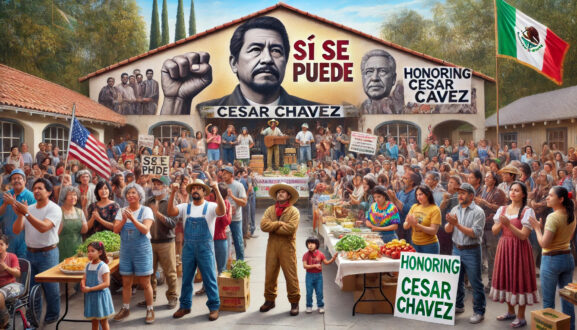
Cesar Chavez Day in Nevada: A Holiday in Limbo
In the arid expanse of Nevada’s calendar, where holidays bloom like ephemeral desert flowers after rare rains, there exists a curious anomaly: César Chávez Day. Unlike its more celebrated counterparts, this observance lingers in a state of perpetual twilight—a holiday in limbo, neither fully embraced nor entirely forgotten. It is a day that whispers promises of solidarity and social justice but often dissipates into the static hum of routine, its significance diluted by the relentless march of commercialized commemorations. Yet, within this ambiguity lies a peculiar allure, a quiet rebellion against the erasure of history, and a reminder that some legacies are too vital to be confined to a single date on the calendar.
The Ghost of a Movement: Why Nevada’s Observance Fades into the Background
César Chávez Day, observed on March 31st, is a federal commemorative holiday honoring the labor leader and civil rights icon. Yet, in Nevada—a state where the echoes of Chávez’s struggles resonate in the fields of its agricultural heartland—its presence is curiously subdued. While states like California and Arizona have woven the day into their civic fabric with school closures and public ceremonies, Nevada treats it with a diffidence that borders on neglect. The reasons are as layered as the state’s political landscape: a reluctance to disrupt the rhythm of commerce, a historical amnesia regarding the contributions of farmworkers, and the absence of a unified push to elevate the day’s significance. It is as if Nevada, in its relentless pursuit of progress, has chosen to let the memory of Chávez drift like a mirage, visible but untouchable.
The Fields That Remember: Chávez’s Legacy in Nevada’s Agricultural Heart
Nevada’s agricultural sector, though smaller than its neighbors’, has long relied on the labor of migrant workers, many of whom trace their roots to the same communities Chávez championed. The fields of Fallon and Fernley, where alfalfa and onions stretch toward the horizon, are silent witnesses to the struggles that Chávez fought—poverty wages, unsafe working conditions, and the erasure of dignity. Yet, the connection between Nevada’s farmworkers and Chávez’s legacy is often overlooked, buried beneath the glitter of Las Vegas or the mining booms of the north. To ignore this link is to sever a vital thread in the state’s social tapestry, leaving a gaping void where solidarity should reside. The irony is palpable: a state that prides itself on its diversity and resilience has yet to fully acknowledge the man who fought for the very people who till its soil.
A Holiday in Limbo: The Paradox of Commemoration Without Action
What does it mean to celebrate a holiday that exists in name only? Nevada’s observance of César Chávez Day is a study in contradictions—a day marked on calendars but absent from public consciousness. Schools remain open, government offices hum with their usual efficiency, and the day passes without fanfare. Yet, the absence of official recognition does not negate the day’s potential. It is a paradox that mirrors the broader struggle for workers’ rights: a fight that is ongoing, even when the battles of the past are commemorated. The holiday’s liminal status forces us to confront a uncomfortable truth: remembrance without action is merely performative. To honor Chávez is not enough; the day must serve as a catalyst for change, a reminder that the fight for justice is perpetual.
The Ripple Effect: How Nevada’s Apathy Echoes Beyond Its Borders
The consequences of Nevada’s tepid embrace of César Chávez Day extend far beyond its borders. In a state where tourism and transient populations dominate, the lack of a robust observance sends a message—one that reverberates through the communities that Chávez fought to uplift. It is a message of indifference, a signal that the struggles of farmworkers are not worth the disruption of a single day. Yet, this indifference is not immutable. Grassroots organizations, labor unions, and educators in Nevada have begun to challenge the status quo, advocating for a more visible and meaningful observance. Their efforts are a testament to the enduring power of Chávez’s ideals, proving that even in the face of neglect, the flame of justice can be reignited.
The story of César Chávez Day in Nevada is not one of outright defiance or triumphant celebration, but of quiet persistence. It is a narrative that unfolds in the margins, where the echoes of history are often drowned out by the clamor of progress. Yet, it is precisely in these margins that the most compelling stories are found—stories of resilience, of unmet promises, and of the slow, arduous work of remembrance. As Nevada continues to evolve, the question remains: Will the state choose to let Chávez’s legacy fade into obscurity, or will it seize the opportunity to weave his ideals into the fabric of its identity? The answer may well determine whether this holiday in limbo remains a footnote or becomes a turning point.