Just 17%: Nevada’s Snowpack Disaster in 4 Charts
Nevada’s snowpack, the lifeblood of its arid landscapes, has plummeted to a mere 17% of its historical average—a stark revelation that underscores the accelerating climate crisis gripping the American West. This staggering deficit, a harbinger of ecological and economic upheaval, demands a granular examination through data visualization and narrative dissection. For policymakers, environmentalists, and residents alike, the following four charts offer not just a snapshot of devastation but a roadmap to resilience—or reckoning.
The Vanishing White Gold: A Statewide Crisis in Snowfall
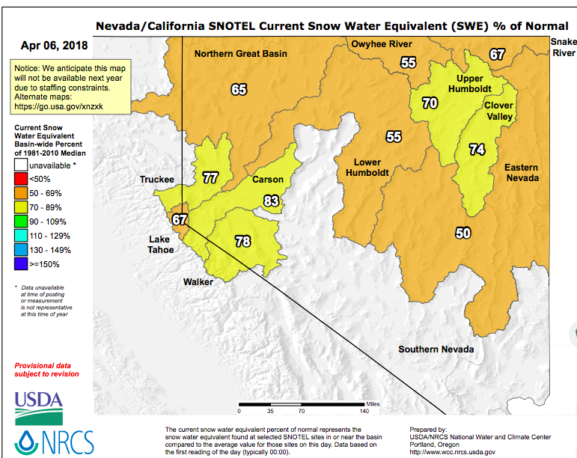
The first chart, a bar graph depicting snowpack levels across Nevada’s major basins, reveals a precipitous decline over the past decade. Peaks that once brimmed with snow in late winter now resemble skeletal remains, their depths reduced to a fraction of historical norms. The Sierra Nevada, Nevada’s primary water source, shows a 78% shortfall compared to the 30-year average. This isn’t merely a seasonal anomaly; it’s a structural collapse of a system that has sustained Nevada’s agriculture, tourism, and urban water supplies for generations. The implications ripple outward: less snow means less runoff, which means reservoirs like Lake Mead and Lake Tahoe are starved of their lifeblood, threatening hydroelectric power generation and municipal water access.
Temperature’s Silent Siege: How Warming Redefines Snowpack
A line graph tracking Nevada’s average winter temperatures against snowpack levels tells a chilling tale. For every degree Fahrenheit increase in temperature, snowpack retention drops by roughly 5%. The data shows a 2.5°F rise over the past 50 years, a trend that accelerates snowmelt and shifts precipitation from snow to rain. This metamorphosis isn’t just academic—it’s a death knell for ski resorts like Lake Tahoe, where snowmaking operations struggle to compensate for nature’s retreat. The psychological impact on communities built around winter sports is profound, as economic forecasts for tourism-dependent regions darken with each passing season.
Groundwater’s Last Stand: The Silent Consequence of Snowpack Depletion
Beneath Nevada’s parched surface, a hidden crisis unfolds. A pie chart illustrating groundwater withdrawal rates versus recharge rates exposes a widening deficit. With snowpack acting as a natural reservoir, its decline forces municipalities and farmers to drill deeper, tapping into ancient aquifers at unsustainable rates. The chart’s data reveals that in some basins, groundwater levels have dropped by over 100 feet in the last two decades. This subterranean hemorrhage isn’t just a local issue; it’s a statewide emergency that could render vast tracts of land uninhabitable within decades. The visual starkness of the pie chart—where withdrawal slices dwarf recharge—serves as a visceral reminder of the finite nature of Nevada’s water resources.
Adaptation or Collapse: The Future in Four Scenarios
The final chart, a multi-line projection, sketches four potential futures for Nevada’s snowpack by 2050. The scenarios range from a best-case mitigation pathway—where aggressive climate policies and water conservation measures stabilize snowpack at 30% of historical levels—to a worst-case trajectory where unchecked warming reduces it to a mere 5%. Each line tells a story: the first, a tale of adaptation through desalination and wastewater recycling; the second, a narrative of managed decline, where controlled urban sprawl and agricultural shifts avert catastrophe; the third, a dystopian collapse of ecosystems and economies; and the fourth, a cautionary tale of inaction. The chart’s power lies in its ambiguity—it doesn’t predict, but it forces confrontation with the choices ahead.
The numbers don’t lie, but they also don’t scream. They whisper warnings through the language of charts and graphs, demanding that we listen before the silence becomes permanent. Nevada’s snowpack is more than a statistic; it’s a living system on the brink, its fate intertwined with the choices of today. The data is clear, but the path forward is not. Will we act, or will we watch as the white gold that once defined Nevada’s winters fades into memory?