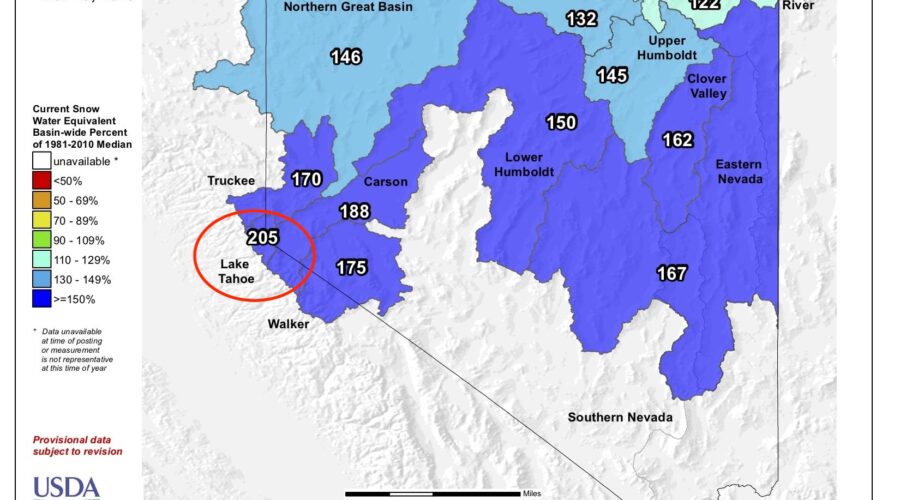
Breaking Overnight: Lake Tahoe Snowpack Plummets to 17%
The Lake Tahoe basin, a jewel cradled in the Sierra Nevada’s embrace, has long been a barometer of the West’s hydrological fortunes. For decades, its snowpack served as a reassuring constant—a frozen reservoir that, come spring, would melt into the lifeblood of rivers and reservoirs downstream. Yet, in a startling reversal of fortune, the snowpack has not merely dwindled; it has collapsed overnight, plunging to a mere 17% of its historical average. This isn’t just a statistical blip; it’s a seismic shift in the region’s ecological and climatic narrative, one that demands closer scrutiny.
The Vanishing Blanket: A Snowpack in Freefall
The numbers are stark. Where once the Sierra’s peaks wore a thick, unbroken mantle of snow, now only skeletal patches cling to the highest elevations. The 17% figure isn’t just below normal—it’s a fraction of what was once considered par for the course. Meteorologists and hydrologists are quick to point out that snowpack is the West’s most reliable water storage system, a natural reservoir that releases its bounty slowly and predictably. But this year, the reservoir is nearly empty. The implications are immediate: reduced snowmelt means lower river flows, stressed aquatic ecosystems, and tighter water restrictions for communities dependent on the Tahoe’s watershed.
What’s more alarming is the speed of the decline. Snowpack doesn’t typically evaporate overnight; it melts, sublimates, or is scoured away by wind and rain. The suddenness suggests a confluence of factors—warmer temperatures that accelerate melt, a dearth of new snowfall to replenish losses, and perhaps a shift in atmospheric patterns that have historically favored the Sierra with heavy winter storms. The result is a landscape that looks almost alien to those accustomed to its winter grandeur, where the once-familiar white expanse has been replaced by exposed granite and skeletal trees.
The Domino Effect: Beyond the Ski Slopes
The ramifications extend far beyond the aesthetic disappointment of a snowless winter. The Tahoe basin is a microcosm of the broader challenges facing the American West, where water scarcity is becoming an inescapable reality. With snowpack at 17%, the region’s water managers are bracing for a summer of shortages. Irrigation districts may face cutbacks, hydroelectric power generation could falter, and the tourism industry—built on winter sports and alpine recreation—will suffer. Even the lake’s famed clarity, a point of pride for the region, could be compromised as reduced snowmelt alters nutrient flows and sediment dynamics.
Ecologically, the impact is equally profound. The Sierra’s flora and fauna have evolved in sync with the snowpack’s rhythms. Pikas, those diminutive alpine residents, are already retreating upslope in search of cooler climes. Forests, too, are under stress, their growth cycles disrupted by the lack of insulating snow. Even the lake itself, a sentinel of environmental health, may see shifts in its delicate balance as warmer temperatures and lower inflows alter its chemistry. The Tahoe is more than a body of water; it’s a living system, and its distress signals are impossible to ignore.
The Unseen Forces: Climate and Consequence
To understand the snowpack’s collapse, one must look beyond the immediate weather patterns and into the deeper currents of climate change. The Sierra Nevada has long been a bellwether for the West’s climatic shifts, its snowpack acting as a natural archive of temperature and precipitation trends. Yet, the data now points to a troubling acceleration. Rising global temperatures are not just melting snow faster; they’re altering the very dynamics of winter storms, favoring rain over snow even at higher elevations. The result is a landscape that is increasingly bereft of the snow that once defined it.
This isn’t a distant threat—it’s happening now. The 17% snowpack isn’t an anomaly; it’s a harbinger. As the planet warms, the Sierra’s snowpack is projected to decline by as much as 60% by the end of the century. The implications for water supply, ecosystem stability, and regional economies are staggering. Yet, there’s a paradox here: the more we understand the forces at play, the more urgent the need for action becomes. The Tahoe’s plight is a warning, one that demands both adaptation and mitigation if the region is to retain its ecological and economic vitality.
The Lake Tahoe basin stands at a crossroads, its snowpack reduced to a shadow of its former self. What happens next will depend on our ability to confront the realities of a changing climate and to rethink our relationship with the natural world. The snow may be gone for now, but the lessons it leaves behind are impossible to ignore. The question is whether we’ll heed them before it’s too late.